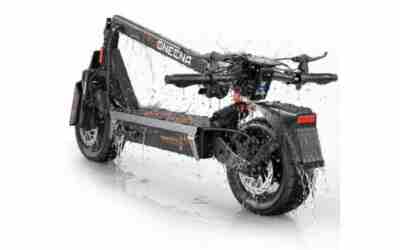

Usually no. Most electric scooter makers tell you not to ride in the rain, even on models with an IPX4 or IPX5 water-resistance rating. Ride wet only if your specific model’s manual allows it.
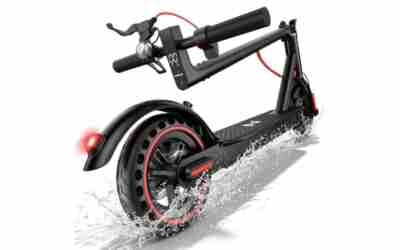
An IP rating describes how a scooter held up in a short lab test. It is not permission to ride through a downpour. Wet roads also cut braking grip, whatever the electronics can tolerate.
What do scooter makers say about wet riding?
| Model | Water rating cited | Maker’s wet-weather guidance |
|---|---|---|
| Segway Ninebot MAX G30P | Check your manual | No riding in rain or snow, or on wet, muddy, icy or slippery roads |
| Segway KickScooter MAX manual | IPX5 | Advises against riding in rain or through puddles |
| Xiaomi Electric Scooter 6 | IPX5 | Advises against riding in rain or snow; cannot withstand prolonged exposure |
| Xiaomi Electric Scooter 4 Pro Plus series | IPX4 | Outdoor riding prohibited on rainy days |
The pattern is clear. Even scooters with an IPX5 rating come with instructions to avoid rain.
These entries summarize published maker material, and the wording can vary by region and manual revision. To check your own scooter:
- Find the model number on its label or box.
- Download the matching manual from the maker’s support site.
- Search the manual for “rain,” “water” and “wet.”
Whatever that manual says overrides general advice about ratings, including this article.
What does an IP water rating actually test?
An IP code has two digits. In IP54, the first digit rates protection against solids like dust, and the second rates protection against water.
An X, as in IPX4, means that position wasn’t rated. It does not mean zero protection.
| Rating | Laboratory water test |
|---|---|
| IPX4 | Splashes from all directions: about 10 minutes with a swinging spray tube, or at least 5 minutes with a spray nozzle |
| IPX5 | Water jet from a 0.25-inch nozzle, about 3.3 gallons per minute, from about 10 feet, for at least 3 minutes |
| IPX6 | Stronger jet from a 0.49-inch nozzle, about 26 gallons per minute |
| IPX7 | Immersion about 3.3 feet deep for 30 minutes; this alone does not show it passes the jet tests |
Water-resistant is not waterproof. These short, controlled tests don’t recreate the conditions a commuter scooter actually faces:
- months of vibration
- tire spray at riding speed
- seals that wear with age
Some retail guides call IP54 or higher fine for light rain. That is their advice, not part of the IP standard.
Also check what the rating covers. Some makers rate the whole scooter, while others rate only one part, such as the battery pack.
How to ride an electric scooter in the rain if your manual allows it
If your manual permits wet riding, stay within its stated limits and change how you ride:
- Test the brakes first. Do this gently, at low speed, in a clear area. Water can change how an exposed disc brake feels, and a wet shoe can slip on a fender brake. Regenerative braking only works while the motor wheel keeps traction. Enclosed drum brakes are better shielded, but the tire can still skid.
- Slow down and leave more room. Brake early and smoothly, accelerate gently, and avoid sharp turns.
- Watch for slick surfaces. Paint lines, metal covers, rail tracks and wet leaves all offer less grip. Cross rails as close to a right angle as you safely can.
- Check your tires. Keep air-filled tires within the specified pressure range and inspect the tread. Don’t underinflate them for extra grip.
- Avoid riding through puddles. Standing water can hide potholes and debris. Go around a puddle only when traffic allows; otherwise, stop safely or walk the scooter past it.
- Be visible and protected. Wear a helmet, eye protection that stays clear in rain, waterproof layers and reflective gear.
Rain also cuts visibility, so check your local lighting law. New York, for example, requires lamps from half an hour after sunset to half an hour before sunrise:
- a white front light visible at 500 feet
- a red rear light visible at 300 feet
- at least one light visible from 200 feet on each side
Don’t ride at all in any of these conditions, whatever your manual says:
- thunderstorms, freezing rain or flooding
- ice or poor visibility
- a cracked or damaged body
- a charging-port cover that won’t stay closed
What should you do if your scooter gets wet?
If rain catches you and your manual prohibits wet riding, get off, switch the scooter off and move it to shelter. Then match your next step to how wet it got:
| Condition | Next step |
|---|---|
| Damp from light spray | Wipe it down and let it dry indoors at room temperature before using or charging it. |
| Soaked in heavy rain | Leave it off and have it checked if moisture reached the display, port or battery area. |
| Submerged | Don’t power it on or charge it. Contact the maker or a qualified repair shop. |
Retailers commonly suggest waiting 24 to 48 hours after wiping. Treat that as a rough minimum, not proof the inside is dry. If your manual gives a waiting period, use that instead.
Never charge with moisture in the port. Don’t speed up drying with high heat or compressed air, which can push water deeper or damage seals.
Have the scooter serviced if you see error codes, a fogged display or corrosion, or if it won’t turn on.
Battery warning signs need faster action, and they can appear hours or days later:
- Swelling, unusual heat or a strange odor: stop using and charging the scooter. Move it away from living areas and exits only if it’s safe to do so.
- Smoke or fire: get away and call 911.
Frequently Asked Questions
Does a scooter warranty cover rain damage?
That depends on your warranty’s written terms, and many exclude it. Segway’s North American F65 warranty, for example, lists water damage as an exclusion. Don’t treat an IP rating as a repair guarantee.
Can I add sealant to make my scooter more waterproof?
Don’t open the scooter or coat its battery, motor or display yourself. Added sealant can trap moisture or heat and put your warranty coverage at risk. It also doesn’t give the scooter a new IP rating.
Can I ride a rental scooter during a rainstorm?
Follow the weather rules in the rental company’s app or terms, and skip the trip during a storm. Being allowed to rent a scooter doesn’t make wet pavement or lightning safe.
Can I hold an umbrella while riding an electric scooter?
No. You need both hands on the handlebars for steering and braking. An umbrella also catches wind and blocks your view. Wear a hooded rain jacket that fits properly with your helmet instead.